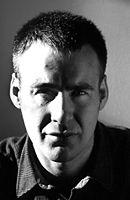
With the recent passing of Glen Carmichael, here is a new review of the cult novel: STILL SEARCHING FOR THE BIG CITY BEATS co-written with his friend, Kevin Evans. Available now from Burning Eye Books.
 |
| Carmichael, Evans and co. |
The spectre of Jack Kerouac casts a knowing eye over Glenn Carmichael and Kevin Evans’ cult novel ‘STILL SEARCHING FOR THE BIG CITY BEATS’ which is now reissued from Burning Eye. Dean Moriarty is reincarnated in 1980’s London as dangerous driving ‘Gene Campbell’, a scene stealing, hard living poet with an eye for the ladies - and men. Echoing the role of Kerouac’s beatific, Sal Paradise and riding shotgun along Constitution Hill in their dented Vauxhall Victor is Gene's sidekick, Spike, straight man and word perfectionist searching for meaning in the repressed, Thatcher-era miasma they inhabit. It is straight man Spike's literate, self-deprecation and parody which invests our interest as the two friends careen around the Buckingham Palace roundabout trying to make their gig. The excitement builds through the tension and eyes of Spike as he wonders if he is really 'ready to.... swallow dive into the maelstrom' with this flamboyant self-seeking apostle, Gene, bent on taking them into the top tier of performance poetry.
 |
| Cult novel reissued |
The novel is fuelled by the friends' failures; a prior musical incarnation as 'The White Brothers' died with a spat on Denmark Street and the tension builds with one man’s desire to transfix the clubs over pubs of 80's seedy Soho London. The 'commissars of the quatrain' take the stage with a vengeance in The Red Lion to breath new life into a dying and abandoned art form. Seizing on the energy vacuum the young friends control the mic and soon 'words richocheted around the walls'. Suggestions that Gene is going to be the 'lifeguard' to a dying scene play on the mind of the more introspective Spike and his fixation on this messianic figure, is the power of the novel's first few chapters. (After speaking with Kevin Evans by phone I was informed that the opening of the novel won a literary prize, and it was the conviction of the two friends Evans and Carmichael to finish the novel as a consequence of this). As 'poetry' is The Big City Beats mutual calling, Spike’s concerns about the very strange nature of poetry assault the opening like beats on a drum in a jazz club: poetry as life tonic is a succession of metaphors expressed as frenzied mind skipping through a Rolodex. Poetry Is everything and nothing, a tired ‘gentlemen’s club’, a ‘wild beast’ a ‘queer fish’. After all, with Spike seeking a release from a stifling Civil Service day job, poetry is all consuming. But in the same space of days it is also ‘an atrophied corpse’ and the rewards are not money nor fame perhaps. Spike admits, ‘Poetry, who needs it?’ The answer and driving force comes from the relentless but unreliable form of charismatic ‘Gene’, who wills Spike to memorise their lines and beat back their audience into full submission to their ‘heavenly light’. The style of writing moves from metaphor to simile and 'that queer fish' poetry never suffers from a lack of time in the spotlight. In the world of the Big City Beats, ‘poetry’ needs a kick up the arse as it is as ‘flaccid as a eunuch’s dick, as dull as dishwater’. Like an odd couple band eschewing definition you wonder how this will all tap out. ‘Your best is not good enough,’ Gene yells at the audience.
If you consider that 'STILL SEARCHING FOR THE BIG CITY BEATS' is a co-authored novel it may be appropriate that this ‘fictive book’, based on real life, asks you to go deeper to try and figure out which poet wrote which part (Evans or Carmichael)? My gut feeling is that the opening, based on the observations of a sidekick, is written by Evans and the descriptions of the lack of organisation at a poetry reading show the point of view of a young passionate man whose anger resonates with his search for meaning. Have the action scenes been penned by Carmichael? How would the novel fare without its clever plotting? The poem ‘Distance’ at the end is a clear example of Carmichael's work and there are readings of it online. It is hard to really know who wrote what but the book is able to easily blend an obviously mutually understood world and the characters crackle, fizz and pop. There’s is humour in the book, when show boating Gene waltzes into an East End caf and sits quietly ‘glum’ while both girlfriends, ‘Maria’ and ‘plain Claire’ hold court over the spoken word poetry scene.
"What is wrong?" asks Spike to his friend who just stares ahead and mutters hollowly that ‘Carver, Raymond Carver has died.’
 |
| BIG CITY BEATS |
This revelation floors Spike as he never knew his friend was a fan of Raymond Carver and the spare response and style may be a homage to the American master of 'less is more'. Spike never knows what Gene is going to do next and despite them seeming to be best friends it shows how little they know about each other outside of the desire to be the next big thing in spoken word poetry. There is a 'Withnail and I' quality about the book, though at times, the admitted ‘angry at the world tone’ is played on frequently. What the book s great at is showing how little we do know about the people we spend time with. The action scenes are comic, perhaps penned by Carmichael (who has recently passed away) but again I don’t know. The scenes of drug taking have maximum impact and show the debauched side of drug addiction, poverty, sex for sale, etc. The celebration of Spike’s birthday on February 14th is filled with pathos and terrible sadness as the boys veer from name checked East End watering holes, like The Blind Beggar, to Murphy’s which is their secret name for the White Hart, all culminating in a quite debauched downward spiral as things literally go south after a disastrous reading at the posh Chelsea Arts and Crafts Fair.
 |
| Danny Boyle, would you option this? |
There is lots of great funny writing about working class observations of ‘Taffs’. The figure of Rhys a kind of stoned bully from hell who persecutes Spike for maximum comic effect is particularly effective as we want Spike to stand up for himself, which he never does. Rhys, described as ‘the blond pale shit-bag, a neurosis and crisis written scumbag’ is over the top so we delight in the mad caper of his sadistic advances. The sadness of the book permeates through but the book has a page turning quality, and would make a decent film as the set pieces, all based a round London landmarks like Pall Mall, Soho, The Red Lion Pub, Soho peep shows, The Blind Beggar, evoke a certain era of East End versus West End rent boys, scenesters, poets and lowlife's of 1980’s London.
I see this book as a film. The scene driving around Buckingham Palace is a page right out of classic cinema and the characters are rip snortingly real, as if the writer had put it down here to get the characters right when the book is filmed. This book has a very dark soul but is honest in its account of real life events which may have occurred at The Hard Edge Club from 1989 till 1995 and it features award winning writing (the first chapter won the East Side Writers award in 1998) and the comedy is there. If there were a sequel I would call it something like Spiked: Withnail’s uncle pops his clogs in Soho.
After speaking with Kevin Evans by phone recently and in light of the recent death of his old friend Glenn Carmichael, I asked Kevin whom he would like to direct the film of this book. One particular person was in my mind but I asked Kevin anyway. "Danny Boyle or someone like that, would do a great job." Are you a director looking for a book set in 1980's London. This one has it all, and deserves its beat, cult status.
Labels: Beatnic, Book Reviews, Civil Servants, East End, Jack Kerouac, Literary Reading, London, London Scene, Poetry, Rock n Roll, Soho, Spoken word, Talent, Thatcher, West End, Withnail and I